
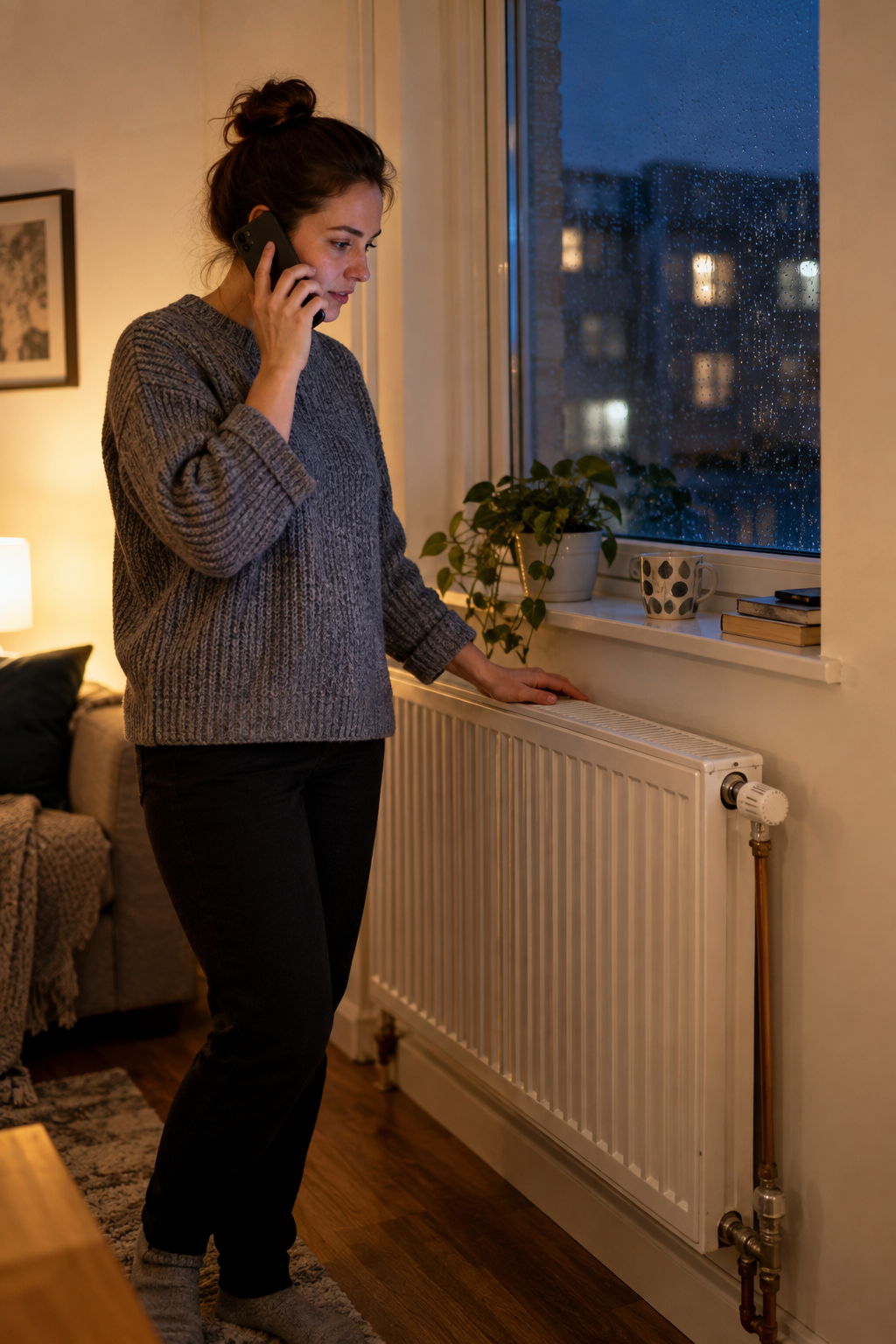
For a Manchester rental repair, save your landlord or managing agent’s reporting route, describe the fault in writing, and keep evidence of what you reported. Call 999 or 112 only when there is an immediate danger to life or serious harm; use the police’s non-emergency route for policing concerns, and follow the current local-authority route when a serious health or safety issue remains unresolved.
At 11:47 p.m. in a flat near Rusholme, Daniel heard water striking the kitchen floor. He had one hand on a tea towel and the other holding his phone, whose battery was already low. The leak was spreading from a ceiling light fitting. His first instinct was to search for “Manchester emergency repairs” and call the first number he saw.
Then he noticed the number belonged to a contractor listed on an old tenancy document. He did not know whether the contractor still worked for his agent, whether the leak counted as an emergency, or what would happen if the light caused an electrical fault. If he chose the wrong route and waited, the damage could worsen overnight. If he switched off the wrong supply or tried to repair it himself, he could make the situation more dangerous.
Daniel found the agent’s current out-of-hours contact in his tenancy email, moved away from the wet area, and reported the problem in writing. He photographed the ceiling, the spreading water and the message he sent. His next steps were clearer because he had separated three different questions: was anyone in immediate danger, who was responsible for receiving the repair report, and what evidence would show that he had reported it promptly?
That separation is the heart of a useful contact plan.
Separate an immediate emergency from a repair report
A repair problem can be urgent without being an emergency requiring the emergency services. A broken extractor fan, a dripping tap, a damaged cupboard or a heating problem may need prompt attention, but the correct first contact is generally the landlord or managing agent’s repair route. Your tenancy agreement, welcome information or agent communications may explain how to report repairs during office hours and outside them.
An immediate emergency is different. If someone is in danger, a fire is developing, there is a serious risk to life, or urgent medical help is needed, call 999 or 112. GOV.UK explains that 999 and 112 are the UK’s national emergency numbers. Give the operator the location, explain what is happening, and follow the instructions you receive.
Leave the property or move to a safer area if you can do so without putting yourself at greater risk. Do not investigate a dangerous electrical fault, enter a flooded area with exposed electrics, or attempt a repair because you are worried about disturbing the landlord. Your immediate safety comes first.
For a problem that needs repair but does not create an immediate threat, report it to the landlord or agent as soon as possible. Use the route they have provided. A general search result, a number copied from an old listing or a number belonging to a contractor you cannot verify may send your report to the wrong place.
The distinction also helps when you contact someone else. A repair report should tell the landlord or agent what has failed and where. An emergency call should explain the danger happening now. A police report should concern a policing matter. A utility contact should concern the utility service or a suspected supply emergency. Mixing these routes can delay the help you actually need.
Save the landlord or agent’s actual reporting route
Create a small contact record before something breaks. Save the landlord’s name, the managing agent’s name, the repair email address, the online reporting page, the main telephone number and any out-of-hours instructions. Keep the details in your phone and somewhere available offline.
Check the information against your current tenancy documents. A previous tenant may have left an old number in a group chat. A letting advert may show a general office line rather than the repair route. A contractor’s sticker on a boiler or fuse box may identify a service company, but it may not be the correct place to authorise or record a repair.
Your record can be simple:
- landlord or agent name
- property address and room where the issue is located
- normal repair-reporting method
- out-of-hours method, if one is provided
- emergency instruction from the tenancy paperwork
- date you checked the details
Do not assume that every repair has the same contact route. An agent may ask tenants to use an online portal for routine issues and a telephone number for urgent problems. The responsible route may change after a property is sold or a management company changes. Save the latest written instruction and note when you confirmed it.
When you report a fault, include the facts someone needs to act:
- your full address and flat or room number
- the room or equipment affected
- what happened and when you first noticed it
- whether the issue is getting worse
- whether water, smoke, gas, electricity, heat or security is involved
- whether anyone is currently at risk
- photographs or video where safe to capture them
- the best way to contact you
Write in plain language. “The bedroom ceiling has a brown mark” is less useful than “Water is dripping through the ceiling beside the light fitting, and the floor is wet.” Avoid guessing at the cause unless you clearly label it as a possibility.
If you call, make a short note of the time, the number used, the person or team you spoke to and what they said would happen next. If the agent asks you to report the issue by email or through a portal, do that promptly. Written reporting gives you a clear record of the date, the facts you supplied and any reply.
Daniel later added the agent’s repair email to his local contact folder. He also saved the out-of-hours instruction as a screenshot. The next time he had a question about a faulty lock, he did not search the whole internet at midnight. He opened the same record and used the route connected to his tenancy.
Record the fault and keep evidence
Good evidence does not require specialist equipment. Start with photographs that show the wider location, then take closer images of the damage. Include a familiar object for scale when useful, but do not put yourself in danger to get a better picture.
Keep copies of:
- photographs and videos
- emails and portal confirmations
- text messages
- call notes
- contractor appointments
- receipts for reasonable steps you were told to take
- any written advice about making the property safe
- updates showing whether the issue improved or worsened
Use filenames that make sense, such as `2026-09-24-kitchen-ceiling-leak.jpg`. Store the files somewhere you can reach if your phone is lost. An offline folder can help when the building’s power or internet connection is unreliable. Aqee’s offline first-night folder guide covers the wider habit of keeping essential arrival information available without a connection.
Do not exaggerate the fault. Evidence is strongest when it is dated, specific and consistent. If the leak stops, record that it stopped and when. If it returns, record the new time. If a room becomes unusable, explain why in practical terms. If you are unsure whether a fitting, appliance or structural element is safe, say that you are unsure and ask for instructions.
GOV.UK’s private-renting guidance explains that tenants should report repair problems to their landlord. It also sets out circumstances in which landlords have responsibilities for repairs, while the exact position can depend on the tenancy and the property. Read the current guidance alongside your agreement, and ask the responsible authority or a qualified adviser when the facts are unclear.
The same principle applies to safety evidence. GOV.UK describes landlord safety responsibilities covering areas such as gas, electrical safety, smoke and carbon monoxide alarms, depending on the relevant legal requirement and property circumstances. Do not treat a missing document, alarm concern or visible hazard as proof of a legal breach by itself. Record what you observed, report it through the proper route, and seek current advice if it remains unresolved.
Use police and utility contacts only for their proper purpose
The police are not a general landlord repair service. Use the police when you need policing assistance, such as reporting a crime or a serious threat connected to your safety or property. GOV.UK’s contact-police guidance explains how to choose between an emergency call and a non-emergency route. If there is an immediate danger, use 999. For a policing concern that is not an emergency, follow the current non-emergency contact guidance.
A broken front door can be a repair issue. Someone trying to force entry is a safety and policing concern. A missing parcel may be a dispute with a landlord, courier or neighbour. A person threatening you at the property may require police help. Describe the event rather than trying to classify it perfectly.
Utility companies have their own role. Contact the relevant provider or emergency service for a suspected supply problem, such as a concern about gas or electricity, using the current contact information available for that service. If you smell gas, feel unwell, see sparks or face another immediate danger, move away from the hazard and use the appropriate emergency route. Do not use a phone in a location where doing so could increase the risk.
A utility contact does not replace a landlord repair report. If the issue also affects the building, fixtures or equipment supplied with the rental, report that to the landlord or agent too. Keep the reference number or confirmation supplied by the utility service, then attach it to your housing record.
This is where incorrect utility advice can cause confusion. A tenant may be told to contact a supplier for something that belongs with the managing agent, or may spend time debating responsibility while a hazard continues. Your plan should allow both reports when both responsibilities may apply. State what you observed, who you contacted and what each person advised.
Escalate a health or safety concern through the current local route
If a landlord or agent does not respond to a serious repair concern, or the response does not deal with the risk, check the current route used by the relevant local authority. Manchester’s current housing and environmental health arrangements can change, so use the official council information available at the time rather than relying on an old blog post, forum comment or copied phone number.
The facts you may need include the property address, the date you first reported the problem, the reporting method, copies of replies, photographs and any continuing health or safety concern. Keep the description focused. Explain what is happening now, what you have already done and why you believe the issue needs further attention.
Citizens Advice’s guidance on getting repairs done in a private rental in England explains practical steps for reporting repairs, keeping records and considering further action when repairs are not completed. It also warns that tenants should understand their position before taking action that could affect rent payments or the tenancy. Do not stop paying rent, arrange major work yourself or deduct costs without current, appropriate advice.
Escalation is not a dramatic final move. It is a documented next route when the original report has not resolved a serious concern. You may need to ask a housing adviser, Citizens Advice or the responsible local authority what applies to your circumstances. Rules can depend on the property, the tenancy, the type of defect and the risk involved.
Return to Daniel’s kitchen. The water had stopped by morning, but the ceiling remained damp and the light fitting had not been checked. He sent a follow-up message with the photographs, quoted the time of his original report and asked for written confirmation of the next inspection. He did not claim to know the cause. He recorded the unresolved safety question and kept the full trail together.
That record gave him something useful even before the repair was completed: a clear account of what happened, when he reported it and which response was still needed.
Save the landlord or agent’s actual reporting route
Turn this into a dated, route-specific task: record the authority that owns the requirement, the official page checked, the evidence available, and when it must be reconfirmed. Organising a record does not establish eligibility, approval, residence, or admission.
What to do next
Create an Aqee local-settlement checklist with one section for rental repairs and emergency contacts. Add the landlord or agent’s current reporting route, the out-of-hours instruction, the property address and a short description of the emergency and non-emergency distinction.
Then test the plan while everything is calm. Open the saved email address or portal. Check that the phone number still belongs to the agent. Make sure the address is visible offline. Ask yourself whether a tired person arriving home late could identify the correct next step in under a minute.
Keep three routes separate:
- immediate danger: move to safety and call 999 or 112 when required
- repair problem: report it promptly to the landlord or managing agent
- unresolved health or safety concern: preserve the evidence and check the current local-authority or advice route
You can also prepare a short message template:
“Property address: [address]. I am reporting [fault] in [room]. I first noticed it at [time and date]. The current risk is [plain description]. I have attached photographs. Please confirm receipt and advise the next step.”
Use the template as a starting point, then add the detail that matters. If the situation changes, send an update. If someone is in immediate danger, deal with the danger first and document the report afterwards when safe.
A contact plan will not repair a ceiling or decide a legal dispute. It does something more practical at the moment confusion usually begins: it puts the right number, the right description and the right evidence in the same place.
Sources
- GOV.UK, contact the police, checked 2026-09-24.
- GOV.UK, 999 and 112 emergency numbers, checked 2026-09-24.
- GOV.UK, private-renting repairs, checked 2026-09-24.
- GOV.UK, landlord safety responsibilities, checked 2026-09-24.
- Citizens Advice, repairs in a private rental in England, checked 2026-09-24.
Related Aqee guide
Keep the practical follow-up in your wider move plan with Aqee’s move-planning guide.