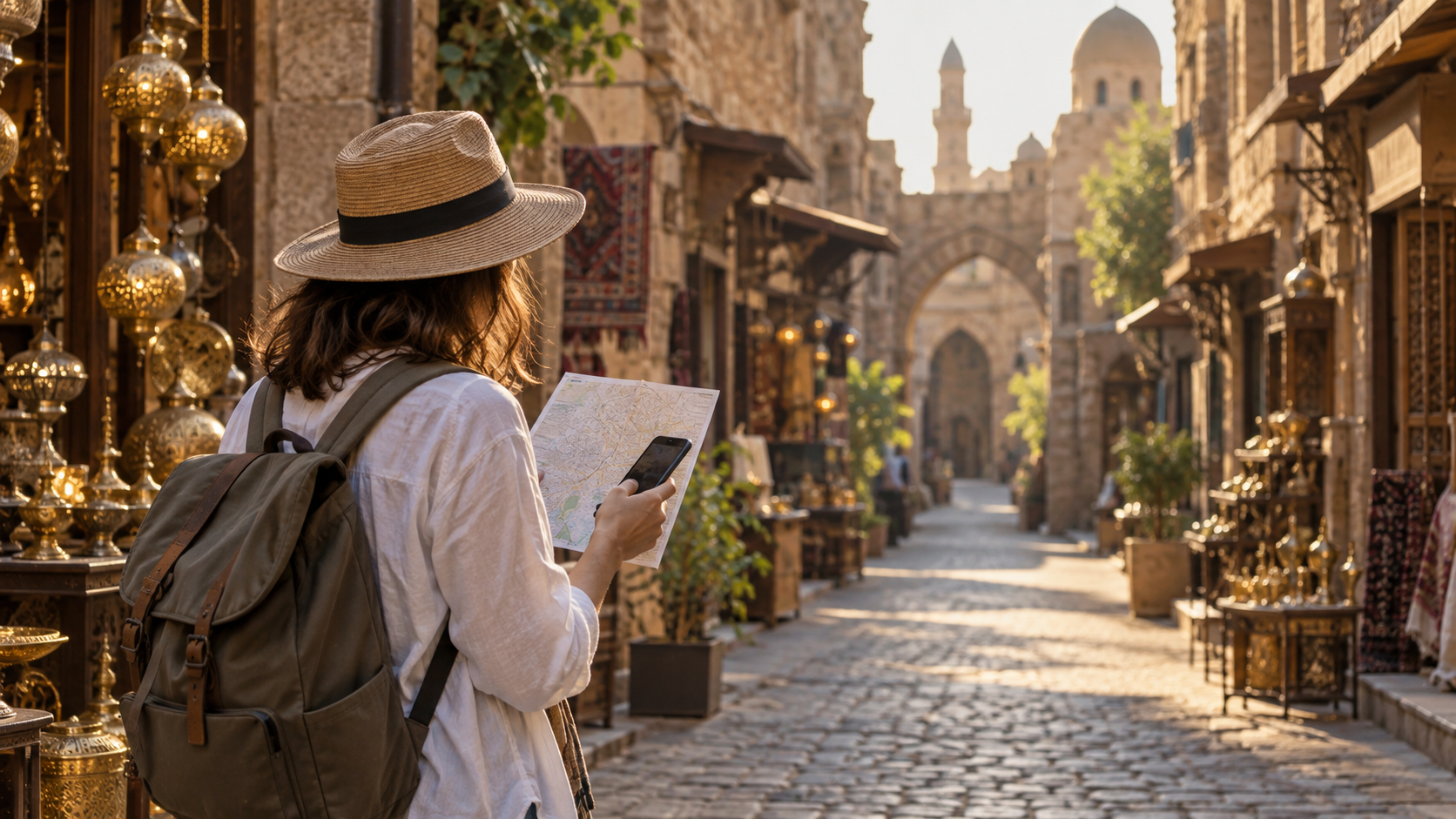
Khan el-Khalili is best approached as a planned Cairo market visit with a defined time window, a manageable route, and enough flexibility to stop, compare, or leave. Before you go, confirm current visitor information through Egypt’s official tourism channels, choose a clear meeting point, carry only what you need, and make each purchase decision at the actual shop rather than treating the market as one large transaction.
Start with a bounded market-visit plan
Set a simple limit before leaving: how long you want to spend, which part of the area you want to see, and what kind of purchases you may consider. Khan el-Khalili can reward wandering, but an unplanned visit can become tiring quickly when you are navigating crowded streets, comparing products, and deciding whether to buy.
A practical first visit might include:
- A fixed start time and an approximate departure time.
- One or two categories of interest, such as gifts, household items, textiles, jewellery, or souvenirs.
- A spending limit in Egyptian pounds.
- A phone with enough battery for maps, translation, and emergency calls.
- A meeting point that everyone in your group can identify.
- A plan for getting back to your accommodation.
The goal is to give yourself room to explore without making every decision under pressure. If you are visiting Cairo during a wider relocation or holiday schedule, place the market visit between activities that require more concentration. You may want time afterward to return to your accommodation, check your purchases, and record what you spent.
Write down the address or location of your accommodation before you leave. Save it in Arabic as well as English if possible. This can make it easier to ask for directions or arrange transport when your phone battery is low, your connection is unreliable, or the area feels unfamiliar.
A bounded plan also helps with energy. Wear footwear suitable for walking on uneven streets, choose clothing appropriate for the local setting, and leave space in your day for delays. You do not need to see every lane in one visit. A shorter first visit can help you learn the layout and return later with better information.
For wider relocation planning, see this practical move-planning guide. The same principle applies here: decide what must happen first, then leave optional choices for later.
Use official information for orientation
Use official sources to confirm practical information before your visit. The Egyptian Tourism Authority provides visitor information and a tourism guide, while the Cairo Governorate publishes information about the city’s historic streets. These sources can help you understand the setting and identify the appropriate official channels for visitor concerns.
Start with the Egyptian Tourism Authority’s official visitor information and its Egypt Tourism Guide. For background on Cairo’s historic urban areas, consult the Cairo Governorate information on Old Streets of Cairo.
Check the source date and look for information that applies to your actual visit. Opening arrangements, transport conditions, public guidance, and local procedures can change. A general tourism guide may explain the character of an area without confirming every detail for the day you plan to go.
Separate three kinds of information:
- Background information, which helps you understand the historic setting.
- Visitor information, which helps you plan your movement and time.
- Safety or official-service information, which tells you where to turn if a concern arises.
Do not treat a travel blog, social media post, hotel recommendation, or shop message as a substitute for a responsible authority when the issue involves safety, official procedures, or a complaint. Informal recommendations can help you decide what to look for, but they may be outdated or specific to someone else’s circumstances.
Before leaving, save the official pages you may need offline. Take screenshots of your accommodation details, your planned meeting point, and any relevant official contact information. Confirm your phone’s roaming or local data arrangement. These steps are small, but they reduce the number of decisions you must make in the middle of a crowded visit.
Choose a route and meeting point
Choose a starting point that you can describe clearly to the people travelling with you. “Somewhere in the market” is a weak meeting arrangement. Pick a location you can identify on a map and explain using nearby landmarks, a named street, or another stable reference.
If your group separates, agree on what happens first. One person may wait at the meeting point for a defined period while another returns there. If the location becomes too crowded or difficult to access, agree on a second meeting point before the visit begins.
Plan the route in stages:
- Start from your arrival point.
- Move through the areas that matter most to you.
- Pause somewhere suitable to check your phone, drink water, or review your budget.
- Leave through a route you have already saved.
- Return to the accommodation or continue to a planned next stop.
A route does not need to be rigid. It needs to be understandable. Keep the first section short enough to learn how the streets connect. If you find a shop or area you want to revisit, save its location immediately rather than relying on memory.
If you are visiting alone, tell someone outside the group where you are going and when you expect to return. Share your accommodation details with a trusted person. Agree on a check-in message, especially if you are unfamiliar with Cairo or have limited local language ability.
Transport planning deserves its own decision. Confirm your departure route before you enter the market. Depending on your circumstances, you may use a pre-arranged driver, a taxi, public transport, or another option. Conditions can vary by time, traffic, location, and provider. Confirm the pickup point directly with the provider and avoid assuming that a vehicle can reach every narrow street.
Keep your phone accessible without displaying it constantly. A small power bank can be useful. If you carry a physical map or written address, keep it separate from your main wallet so one lost item does not remove every way to navigate back.
Carry only what is needed
Take the items required for the visit and leave unnecessary valuables in a secure place. Carry enough cash for the purchases you may make, but avoid displaying your full budget while comparing products. Keep identification, payment cards, and cash in a way that lets you access one without exposing everything else.
Your practical kit may include:
- A charged phone and power bank.
- Accommodation details in Arabic and English.
- A small amount of cash in suitable denominations.
- One payment card, if you plan to use one.
- Water and any personal medication you need.
- A reusable bag if you expect to buy small items.
- Sunglasses or other items appropriate for the weather.
- A note with emergency and official contact details.
Do not carry your passport unless you have a specific reason and have confirmed that you need it. Keep any essential identity document secure and follow the instructions of your accommodation, travel provider, or responsible authority.
Dress for walking and for the local environment. Practical clothing can make the visit more comfortable and reduce the need to adjust your plans because of heat, dust, crowds, or uneven surfaces. The best choice depends on the season and your personal needs, so check current conditions before leaving.
If you have accessibility requirements, check the route in advance and plan for sections that may be difficult. Historic streets can have uneven surfaces, narrow passages, steps, or crowded areas. An official source may provide general orientation without giving detailed accessibility information for every route. Contact your accommodation or a responsible local provider before the visit if you need a specific access arrangement.
Make purchases as separate decisions
Treat each purchase as its own decision. A lively market atmosphere can encourage quick choices, especially when several products, prices, and conversations compete for your attention. A short pause gives you time to assess the item, the price, the payment method, and whether you actually want it.
Before buying, check:
- What exactly is included in the price.
- Whether the item is new, used, handmade, repaired, or presented as another category.
- The currency and amount you are being asked to pay.
- Whether the price applies to one item or a group of items.
- Whether shipping, packaging, or another service costs extra.
- Whether you can inspect the item before payment.
- Whether the shop provides a receipt or another record of the transaction.
- What happens if the item has a defect or cannot travel with you.
Ask for the price clearly and confirm your understanding before handing over money. If you do not understand the answer, pause. Use a translation tool or ask someone you trust to help. A transaction becomes difficult when the buyer and seller are using different assumptions about quantity, quality, currency, or delivery.
Decide in advance how much negotiation you are comfortable with. Bargaining may be part of some market transactions, but you do not have to continue a conversation that feels uncomfortable. You can thank the seller and leave. Comparing two or three similar items can help you make a calmer decision, although prices may reflect differences in materials, craftsmanship, size, condition, or the seller’s terms.
Avoid buying an item solely because you feel pressured to be polite. A purchase should fit your budget, luggage, intended use, and confidence in the transaction. If you are moving countries, consider customs rules and airline restrictions before purchasing food, plants, animal products, liquids, antiques, or other controlled items. The responsible authority for those rules may be your destination country’s customs service, your airline, or another official body. Check the current rules rather than relying on a seller’s assurance.
Photograph your receipt and the item after purchase. If the shop gives you packaging or care instructions, keep them with the item. Record the shop name or location while it is fresh in your mind. These simple records can help you remember what you bought and whom to contact if a genuine issue arises.
Keep personal safety and official channels clear
Keep personal safety decisions separate from shopping decisions. If someone behaves aggressively, follows you, blocks your movement, or creates another safety concern, focus on leaving the situation and reaching a safer place. You do not need to finish a purchase or settle a disagreement before moving away.
Use the official channel that matches the concern. The Egypt Ministry of Interior provides information about the Tourism and Antiquities Police. Review the current official information before your visit so you understand where to seek help if a safety issue arises.
For an immediate emergency, use the appropriate local emergency service. If the situation concerns a shop transaction, keep a record of the shop, receipt, payment, and item, then seek guidance through the relevant official or consumer channel where available. Do not present a general tourism page as an emergency contact unless it explicitly provides that function.
A complaint and an emergency require different responses. A disagreement about price may call for documentation and a formal complaint route. A threat or immediate danger requires distance, assistance, and urgent contact with the relevant authorities. Keeping those routes distinct helps you act quickly.
Be careful with personal information. You do not need to share your accommodation room number, travel schedule, passport details, or financial information with a seller or stranger. If someone offers to solve a problem by taking your documents or arranging an unofficial service, pause and verify the offer through a responsible authority or trusted provider.
Keep a market visit separate from immigration and residency
A visit to Khan el-Khalili is a tourism and local-orientation activity. It does not replace immigration, visa, residence-permit, or other official procedures. Do not assume that information from a shopkeeper, guide, driver, fellow traveller, or online comment applies to your immigration status.
Keep your relocation records separate from your shopping notes. If you are living in Egypt or preparing to move there, maintain a separate checklist for:
- Passport and visa information.
- Residence or permit records.
- Renewal dates.
- Appointment details.
- Official correspondence.
- Copies of submitted documents.
- Questions for the responsible immigration or consular authority.
Requirements, deadlines, fees, and document rules can vary by nationality, permit type, location, and personal circumstances. Confirm them through the authority responsible for your case. A market visit may help you become familiar with your new city, but it cannot confirm eligibility or extend a permit.
This separation prevents a common planning error: allowing a memorable local experience to create false confidence about an administrative task. You can enjoy the market and still return to the serious work of checking your permit timeline, saving official contact details, and preparing the documents your case actually requires.
A broader Day 0 plan can help you keep these categories visible. For example, a Montreal first-week budget guide treats early settlement decisions as practical tasks that need timing, records, and realistic spending limits. Apply the same discipline to your Cairo planning.
What to do next
Before your visit, complete five actions:
- Open the official Egyptian Tourism Authority visitor information and save the pages relevant to your trip.
- Check the Cairo Governorate material for orientation on historic streets and the area’s context.
- Save your accommodation address, route, meeting point, and departure plan offline.
- Set a spending limit and write down the purchase categories you may consider.
- Save the Egypt Ministry of Interior Tourism and Antiquities Police information so you know which official channel to review if a safety concern arises.
After the visit, record what you bought, what you spent, and any route or accessibility detail you would want to remember. If you are settling in Cairo, create an Aqee local-settlement checklist. Include the market visit as one local orientation task, then add separate entries for transport, communications, healthcare, banking, accommodation, immigration records, and permit dates.
A clear checklist gives the visit a useful place in your relocation plan. You can explore, compare, and enjoy the streets while keeping purchases, safety concerns, and official residency matters in their proper lanes.
Sources and update note
Review the current Cairo Governorate information on Old Streets of Cairo, Egypt Tourism Guide, Egyptian Tourism Authority visitor information, and Egypt Ministry of Interior Tourism and Antiquities Police information before travelling. Official information, access arrangements, safety guidance, and administrative procedures can change, so confirm details close to your visit.
Sources
- Cairo Governorate, Old streets of Cairo, checked 2026-09-25.
- Egyptian Tourism Authority, Egypt Tourism Guide, checked 2026-09-25.
- Egypt Ministry of Interior, Tourism and Antiquities Police, checked 2026-09-25.
- Egyptian Tourism Authority, official visitor information, checked 2026-09-25.
Related Aqee guide
Keep the practical follow-up in your wider move plan with Aqee’s local activities planning guide.