
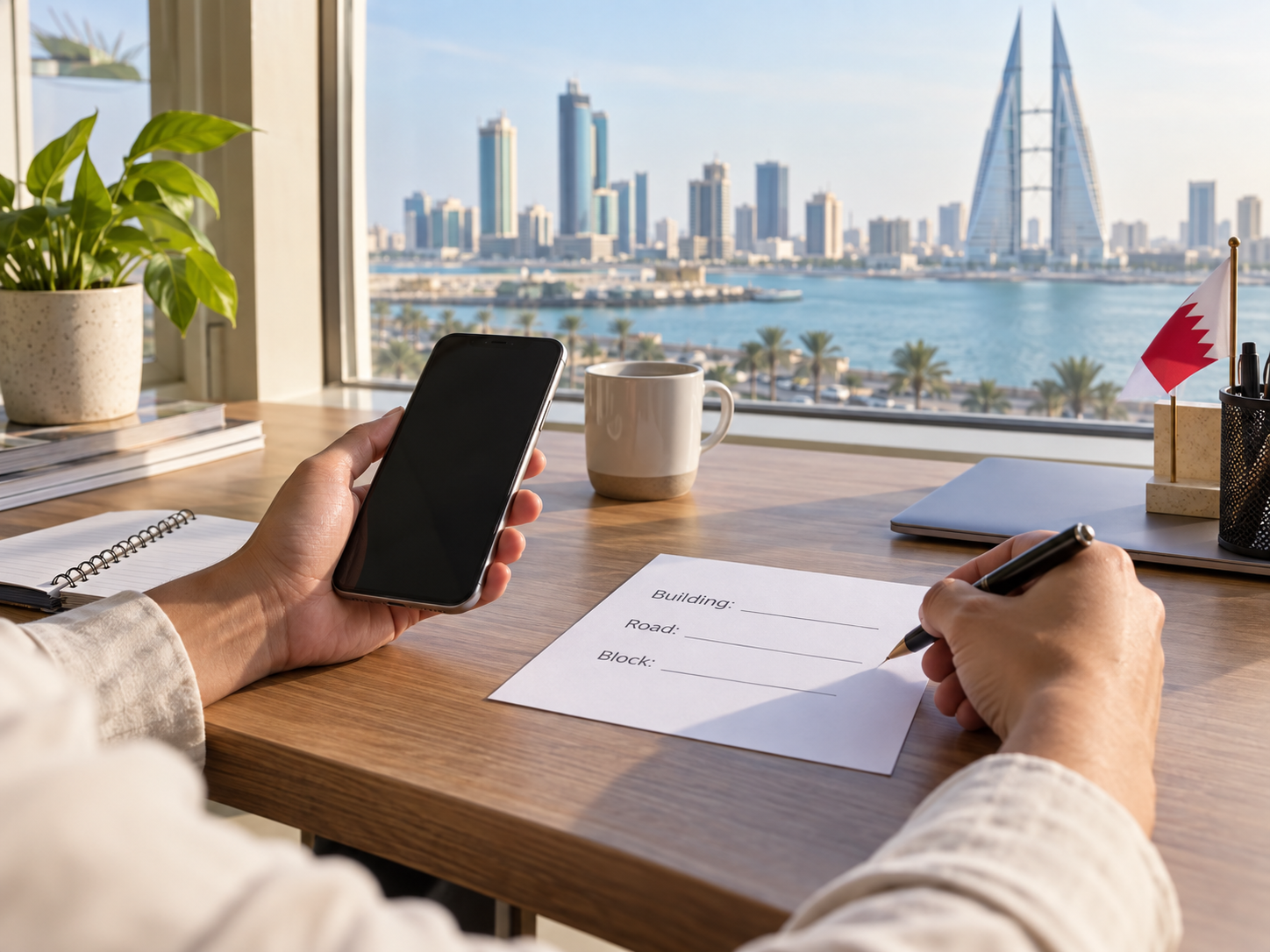
For Manama address records, keep the exact building number, road number and block number together from the current address document, then confirm what the receiving organisation wants before you submit anything. Bahrain’s address services and property-related records follow their own routes, so an address detail used for a building service may not meet a bank, employer, immigration office or utility provider’s evidence requirements.
Identify the address record you actually need
Start by naming the task in one sentence. “I need the address details for a property service” leads to a different preparation path from “I need proof of my residence for an organisation.”
This distinction matters because a Manama address can appear in several contexts:
- A building or establishment address record.
- A personal residence record.
- A document requested by a bank, employer, landlord, university, telecom provider or public authority.
- A property-related service connected to a building, establishment or premises.
- A supporting document used alongside identity, tenancy or residence paperwork.
The first question is therefore: what decision will the receiving organisation make from this record?
If you are updating a personal profile, the organisation may need to confirm where you live. If you are dealing with a property or establishment, it may need the building’s registered location. If you are applying for a service, the provider may have a separate form, account record or verification process.
Do not assume that a document containing your building, road and block details automatically proves every other fact about your situation. An address record can identify a location without proving tenancy, ownership, immigration status, employment, utility payment or permission to occupy the property.
Before opening a service page or booking an appointment, write down:
- The exact service or account you are trying to complete.
- The organisation receiving the information.
- The name of the document or record they requested.
- Whether they asked for an original, a digital copy, a recent record or a document showing your own name.
- Whether they also requested identity, tenancy, ownership or residence evidence.
This small preparation step prevents a common delay: collecting a correct address record that answers a different question from the one the receiving organisation asked.
Capture building, road and block details accurately
When a form asks for a Manama address, copy the location details exactly from the relevant current record. Avoid reconstructing the address from memory, a delivery message, a map pin or an old document if a newer official record is available.
Check each part separately:
- Building number.
- Road number or road name, where shown.
- Block number.
- Any additional unit, flat, floor, shop or establishment detail shown on the record.
- The governorate, municipality or locality, if the form requests it.
- Any reference number, record number or date associated with the document.
Building, road and block numbers can look similar when copied quickly. Keep them in separate fields while preparing your application. A practical working note might use this structure:
Building: [exact number shown on the record] Road: [exact number or name shown on the record] Block: [exact number shown on the record] Unit or additional detail: [only if shown or requested]
Do not add information that is absent from the record simply to make the address look more complete. If the form requires a field that your document does not show, ask the receiving organisation how it expects that field to be completed.
Pay attention to numbers that may be transposed when entered manually. Compare the final form with the source document character by character. If you are working from a scan or photograph, check that the number is readable and that no digit is hidden by glare, cropping or compression.
Keep the source document available after entering the information. You may need to confirm the details during a call, appointment or follow-up request. Save a clear copy according to the organisation’s privacy instructions, and avoid sending address documents through an unverified contact channel.
The safest recordkeeping approach is to keep three items together:
- The current address document.
- Your typed building, road and block details.
- The receiving organisation’s written evidence request.
That gives you a direct comparison when a form, email or staff member asks for clarification.
Keep property services separate from personal paperwork
Bahrain’s Information and eGovernment Authority provides information about Building and Establishment Address services. Those services concern address information connected to buildings or establishments, while another organisation may be asking for personal evidence connected to you as an occupant, applicant, customer or resident.
Treat these as separate workstreams unless the responsible authority or receiving organisation confirms that they can be combined.
A property or establishment address task may require you to identify the premises and its registered location. A personal paperwork task may require your name to appear on a document, or may require a tenancy, ownership, identity or residence document in addition to the address details.
The difference affects what you should prepare. For example, a building address record may help identify where a premises is located. It may not answer whether you rent a particular unit, own the property, occupy it lawfully or have a current relationship with a service provider.
Before using an address record for personal paperwork, check:
- Does the document show your name?
- Does it identify the specific unit or only the building?
- Does it show a current date or issue information?
- Does it identify the property, establishment or residence?
- Does the receiving organisation require a separate tenancy, ownership or account document?
- Is the document being used for address confirmation, or for a different purpose?
If the task concerns an establishment, keep the establishment’s information separate from your private residence information. Mixing the two can create confusion, especially when a person works at one address, lives at another and needs to provide evidence for both.
A useful rule is to label each file by purpose rather than by location alone. “Manama address record” is too broad. “Building address record for property service” and “personal residence evidence for bank request” will help you avoid attaching the wrong document later.
This separation also reduces unnecessary disclosure. Give each organisation the information it needs for its stated purpose. Do not send an entire property file when the organisation has asked only for a specific address record.
Check the current iGA channel before visiting
The Information and eGovernment Authority is the responsible source for current information about its address services, contact details and customer-service channels. Review the current iGA pages before travelling to a service centre because opening arrangements, appointment processes and available services can change.
The iGA has published information about Building and Establishment Address services and has also published updates about address-service appointments at the Isa Town Customer Service Center through the Mawaaed app. The update refers to appointment booking for address services from 1 February 2026. Check the current page before relying on that route, especially if your task is time-sensitive or you are travelling from another area.
The iGA also provides contact and premises information, including Isa Town service information. Use those pages to confirm the current location and contact route instead of relying on an old message, an unofficial directory or a map result that may not reflect the service currently available there.
The iGA’s Virtual Customer Service Center is another channel to check where your question can be handled remotely. Its availability and the types of help provided may depend on the service and the current operating arrangements. Confirm the channel before assuming that an online conversation replaces an application, appointment or supporting document.
Before you visit or book, prepare a short question:
“I need to confirm the correct address-service route for building number, road and block details. The record will be used for [state the receiving organisation or property task]. Which current channel should I use, and what evidence should I bring?”
Have your identity information, current address record and receiving organisation’s request available when contacting the authority. Do not send sensitive documents until you are using an official channel and understand why each document is required.
If a web page gives general information but your circumstances are unusual, ask the authority to confirm the route. Address records can involve different property, establishment and personal situations, so a general page may not resolve a specific discrepancy.
Ask each receiving organisation for its own evidence
The organisation receiving your address information controls its own evidence list. A bank, university, employer, telecom provider, landlord, utility provider or government body may ask for different combinations of documents, even when the same building, road and block details appear on each form.
Ask for the requirements in writing where possible. A clear message can be simple:
“Please confirm which document you accept as proof of address, whether it must show my name, whether it must be current, and whether you also require tenancy, identity or account evidence.”
Ask these questions before submitting:
- What exact document name do you accept?
- Must the document show the applicant’s name?
- Does it need to show the full building, road and block details?
- Is a unit, flat or floor number required?
- How recent must the document be?
- Is a digital copy accepted?
- Are translations, attestations or original documents required?
- Can the organisation accept an address record together with another supporting document?
- What should you do if the address on the record differs from the address in your application?
- Which department should receive the document?
Do not infer acceptance from another organisation’s policy. A document accepted by a telecom provider may not meet a bank’s onboarding requirements. A document used for a property service may not satisfy an employer’s personnel file request.
If the organisation rejects the record, ask which specific part was insufficient. The problem may be the document type, missing name, outdated date, absent unit detail, unreadable scan or mismatch between the address and the application. Correcting the precise issue is faster than collecting unrelated paperwork.
Keep a short evidence log with the organisation’s name, contact date, requested documents and any follow-up instruction. This is especially useful when several organisations are updating records at the same time.
For privacy, send only what the organisation requested. Review the recipient address, upload page and file attachments before pressing send. Remove unrelated pages where the organisation permits partial submission, but keep the complete source document stored securely in case the authority or recipient asks to inspect it later.
Resolve mismatches before submitting
An address mismatch can involve a single digit, a different spelling, an old road description, a missing unit number or a document that refers to a building while the receiving organisation expects a personal residence.
Do not edit an official record yourself to make it match a form. Instead, identify the difference and ask the relevant authority or receiving organisation which record should control.
Use this comparison:
| Item | Source document | Receiving form | |—|—|—| | Building | Exact value | Entered value | | Road | Exact value or name | Entered value | | Block | Exact value | Entered value | | Unit | If shown | If requested | | Name | If shown | Applicant name | | Date or reference | Current document details | Requirement |
If only the formatting differs, ask whether the organisation accepts both formats. If the numbers differ, pause the submission until the source is confirmed. A small discrepancy can cause a verification failure even when you are physically at the correct location.
If your accommodation has changed, do not continue using an old record simply because it was accepted previously. Confirm whether you need a new record or a separate current document. The correct next step depends on the service and the receiving organisation.
What to do next
Create an Aqee local-settlement checklist with separate sections for address records, property or establishment services, personal paperwork and organisation-specific evidence.
Add the following fields:
- The task you are completing.
- The receiving organisation.
- The exact document requested.
- Building number.
- Road number or name.
- Block number.
- Unit or additional property detail.
- Whether your name must appear.
- Required document date or validity period.
- Official iGA channel checked.
- Appointment or online-service details, if applicable.
- Submission date.
- Follow-up contact and outcome.
Then open the current iGA contact and premises information, review the Building and Establishment Address services, and check the latest appointment information before deciding whether to visit or use a digital channel.
For broader preparation, a country-specific visa and permit plan before Day 0 can sit alongside your local address checklist. Keep the two plans separate: immigration conditions determine what you may need to do, while address records help you document a specific location for a specific service.
Complete the checklist by attaching the current source record and writing down the receiving organisation’s own evidence instructions. That gives you a usable local-settlement file instead of one generic address document that may be unsuitable for the next task.
Source and update note
This guide was prepared from the Bahrain Information & eGovernment Authority’s contact and premises information, Building and Establishment Address services, Isa Town appointment update, Virtual Customer Service Center update, and Isa Town service information. Check the official iGA pages again before acting because channels, appointments and service instructions can change.
Sources
- Bahrain Information & eGovernment Authority, contact and premises details, checked 2026-09-25.
- Bahrain Information & eGovernment Authority, Building and Establishment Address services, checked 2026-09-25.
- Bahrain Information & eGovernment Authority, address-service appointment update, checked 2026-09-25.
- Bahrain Information & eGovernment Authority, Virtual Customer Service Center update, checked 2026-09-25.
- Bahrain Information & eGovernment Authority, Isa Town service information, checked 2026-09-25.
Related Aqee guide
Keep the practical follow-up in your wider move plan with Aqee’s immigration-paperwork guide.


